
The family
Picidae · 17 species photographed
India has around forty woodpeckers, from a piculet the size of a thumb to the crow-sized White-bellied. I have photographed seventeen of them. This page shows five; the rest are in the archive and will make their way here. The list below is what the camera has actually caught, not what I have seen.
across India
so far
while drumming
Species list drawn from my eBird records carrying photographs. Flameback identifications on this page are provisional — see the notes.
Hitting wood with your face
How the head survives the job
A drumming woodpecker strikes at around twenty beats a second, decelerating each time at forces that would put a person in hospital.
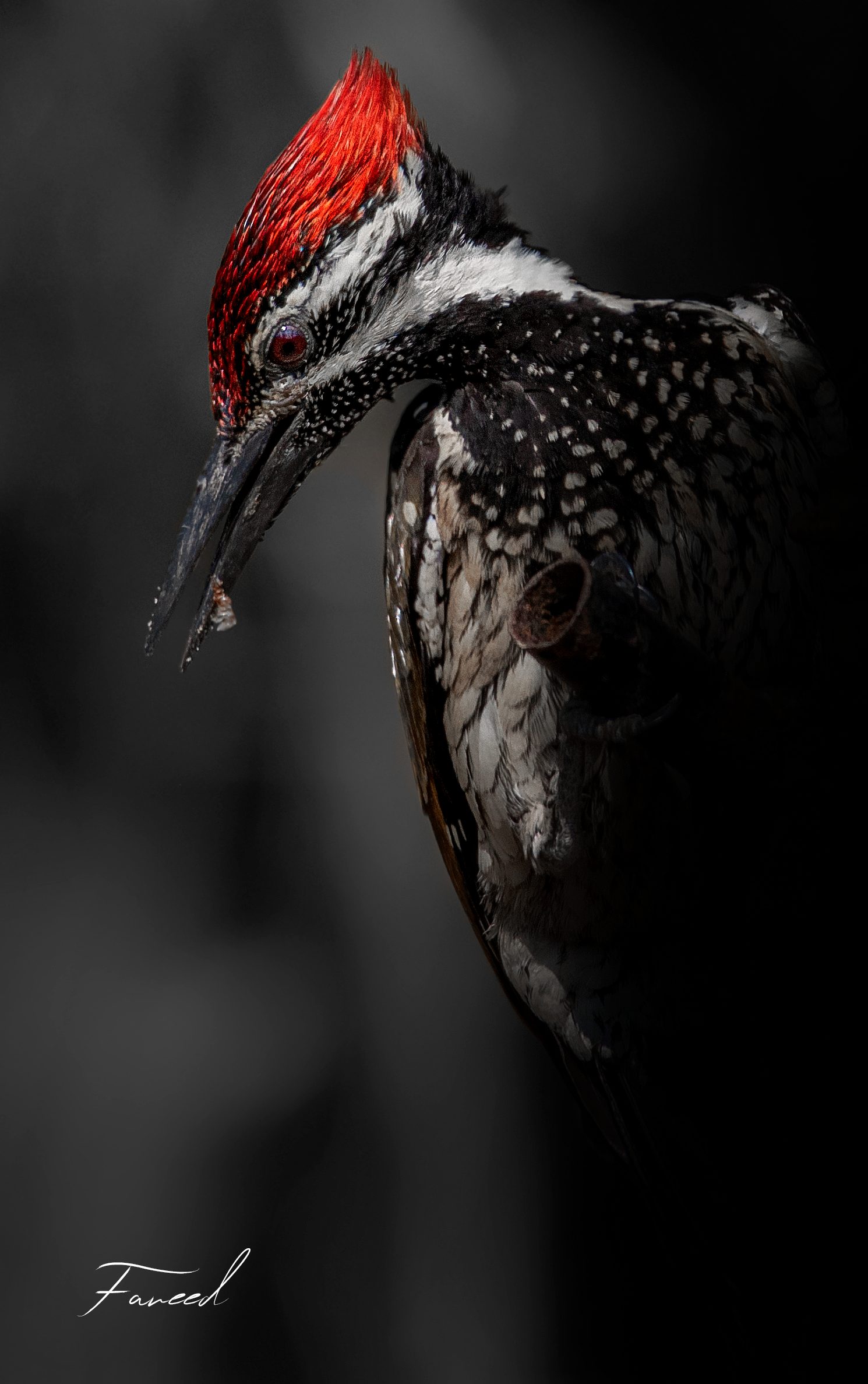
It gets away with it through a set of adaptations that all point the same way: a thickened, spongy skull; a lower mandible slightly longer than the upper, so shock is routed into the jaw rather than the braincase; and a brain small and tightly packed enough that it barely moves inside the skull.
Then there is the tongue. It wraps from the back of the bill, under the jaw, around the rear of the skull and over the top of the head, anchoring near the nostril — a hyoid apparatus long enough to shoot far past the bill tip and probe a tunnel, and which doubles as a strap around the braincase.
Everything else follows from the same trade: two toes forward and two back for grip, stiffened tail feathers braced against the trunk like the third leg of a tripod, and a body plan that only makes sense vertically. Which is why almost every frame here is a bird on the side of something.
The frames
016 frames · southern India
Field notes
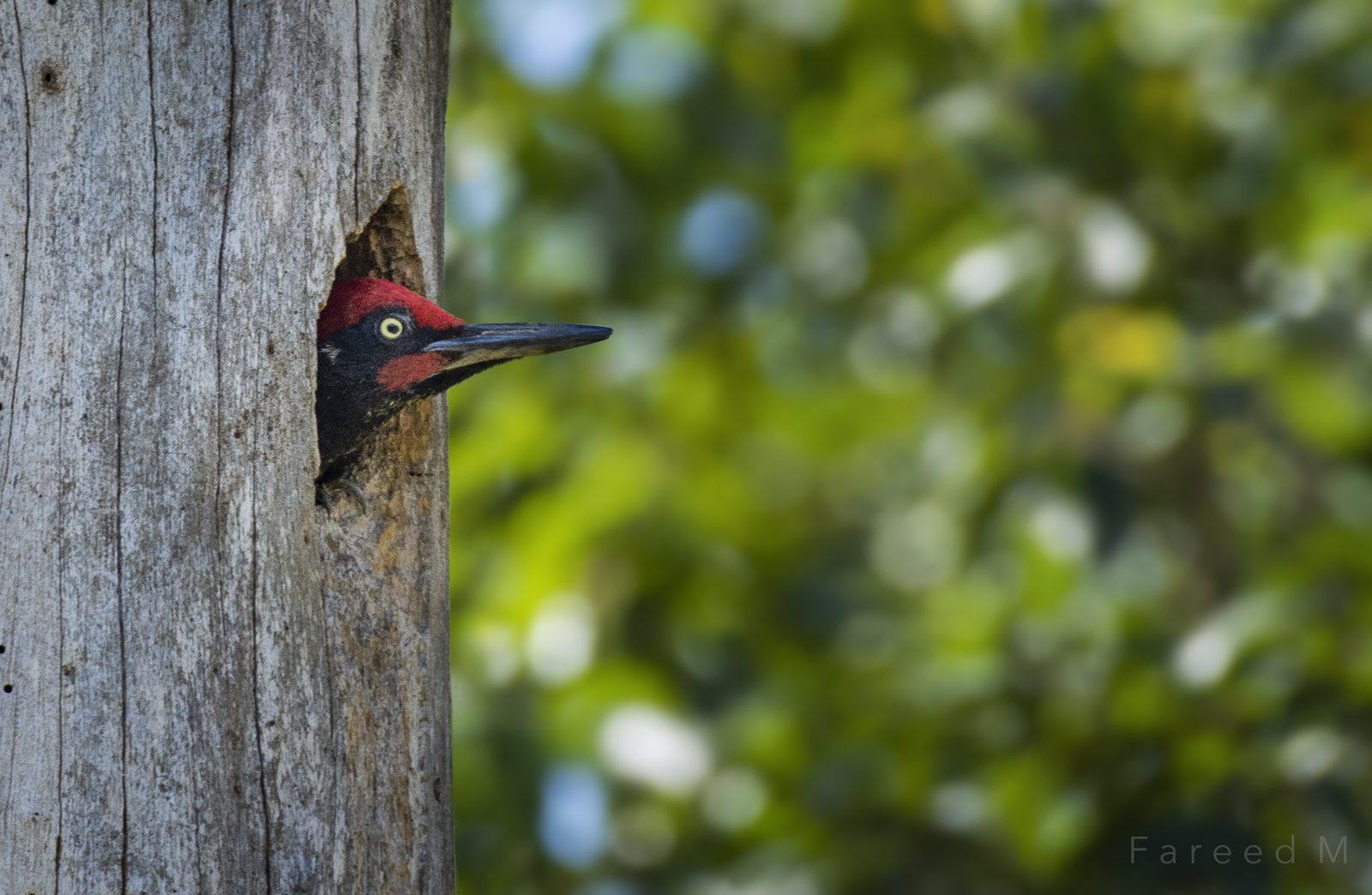
Woodpeckers are found by ear long before they are found by eye. The drumming carries, and each species has its own rhythm and pitch — but the sound bounces off trunks, so the bird is rarely where you first think it is. Walk in slowly, stop, and wait for the next burst.
Almost all of these are made against a dark background, which is not styling so much as circumstance: the birds work the shaded side of trunks, and if you expose for a bird lit by a shaft of morning sun, the forest behind it falls to black on its own.
A caveat on the flamebacks. Several frames here are golden-backed woodpeckers that I have labelled by best judgement. Black-rumped Flameback and the larger Chrysocolaptes flamebacks — Greater, Malabar, Common — overlap in range and look alike at a glance; the reliable marks are the divided cheek stripe, the eye colour and the rump. My eBird records include Black-rumped, Greater, Malabar and Common Flameback, so more than one of them is on this page. Where I am not certain, the caption says so.