
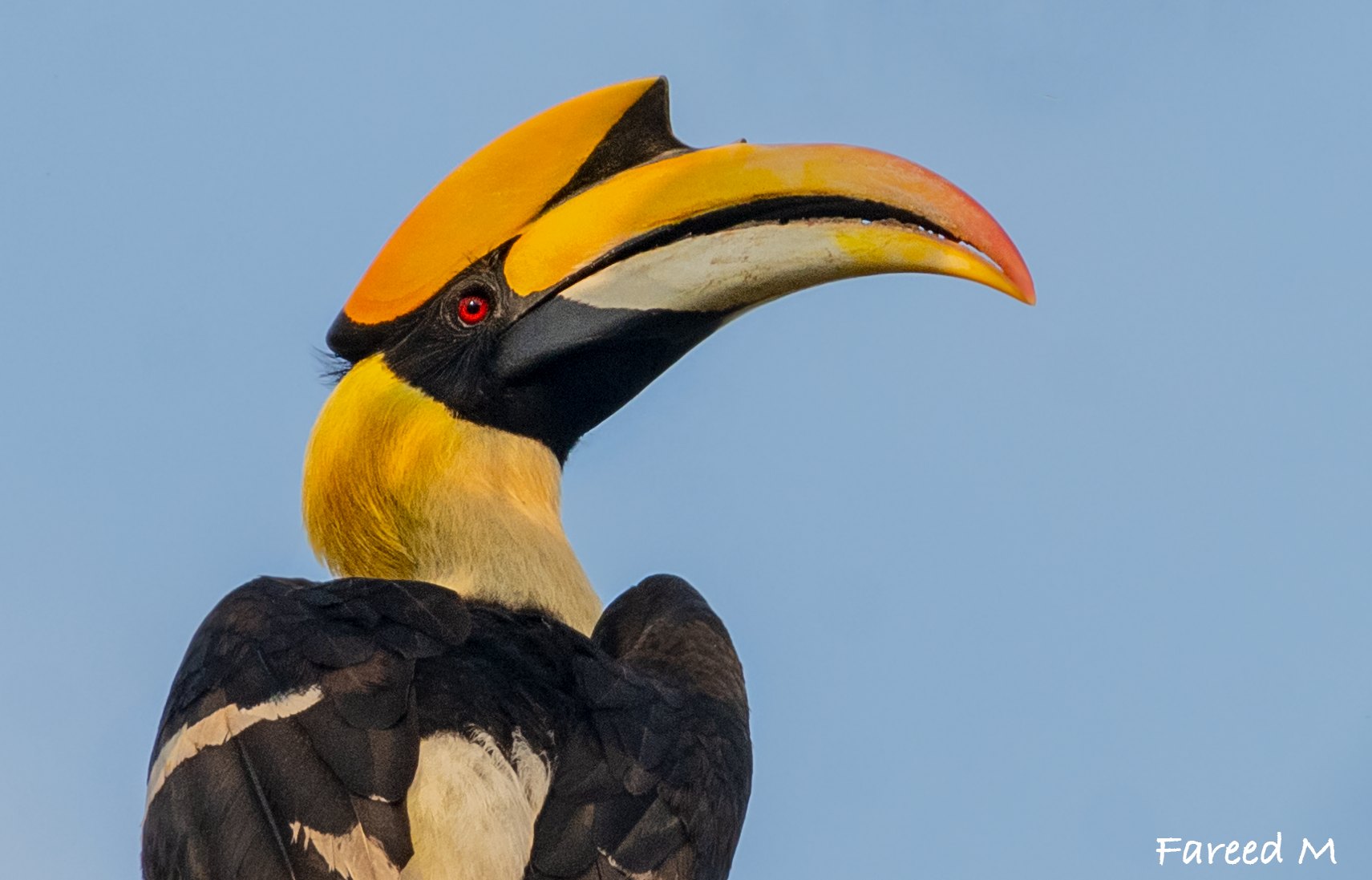
The sealed nest
One breeding cycle · Western Ghats
Great Hornbills cannot make their own nest holes. They need a cavity already present in a large, old, hollow tree — and then the female does something no other bird family does quite this way. She goes inside and seals herself in, plastering the entrance down to a slit barely wide enough to pass a fruit through. For roughly four months she does not leave. Everything she and the chick eat comes through that slit, delivered by the male, one fig at a time.
Timings are approximate and vary by site and season. In the Western Ghats the cycle runs broadly from late January to June, and depends entirely on a suitable cavity being available.
sealed inside
successful nests
you hear first
can be used
The casque
One shaft of light through the canopy
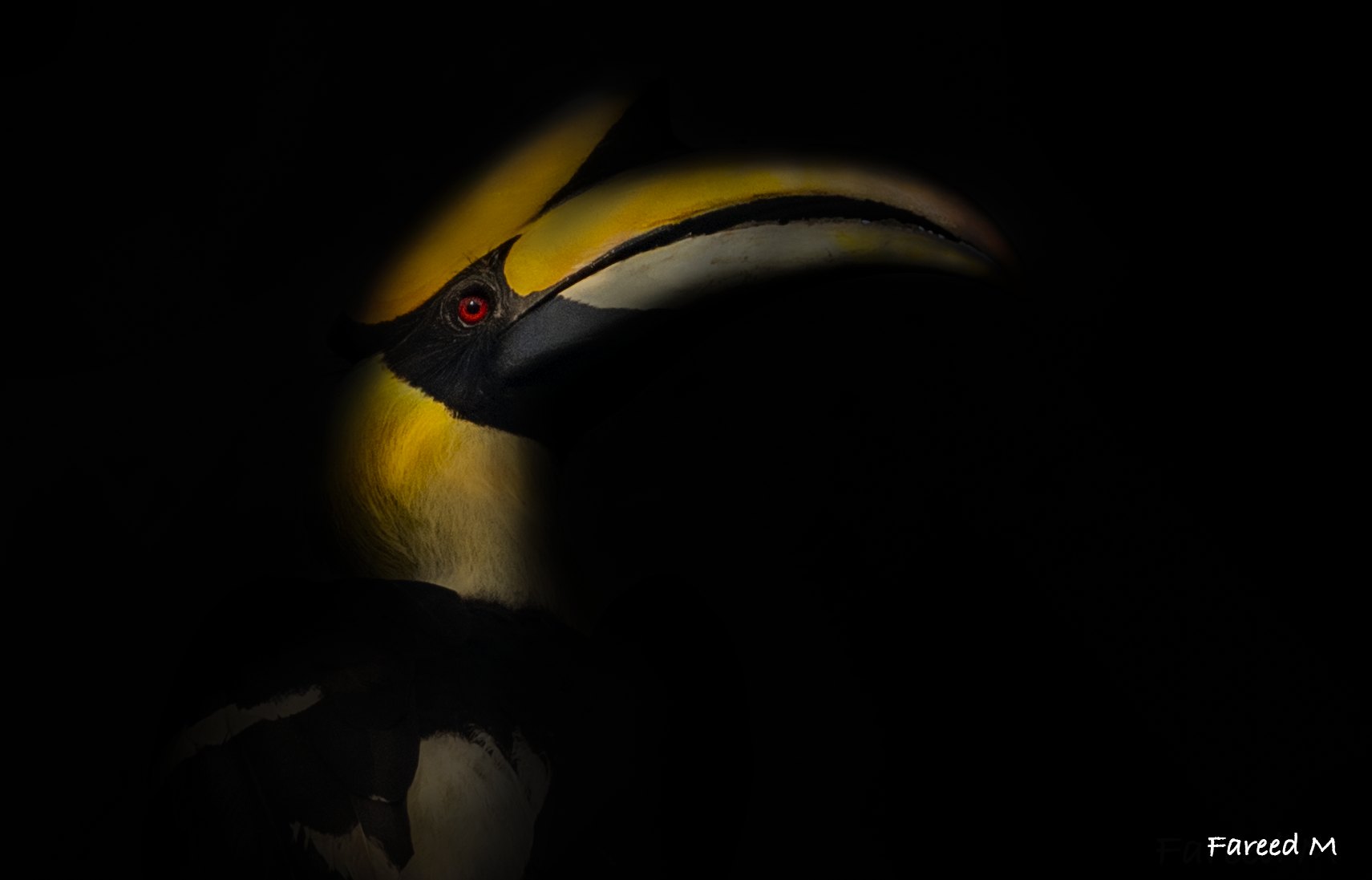
The thing on top of the bill looks like it should be unbearably heavy. It is mostly air.
The casque is a hollow structure of keratin over a lattice of thin bone struts — closer to a helmet than a horn, and light enough that a bird carrying one can still work the outer branches of a fig tree. Both sexes have one. The male's is larger, and his eye is red where the female's is white, which is the quickest way to sort a pair at distance.
The yellow is not pigment in the usual sense. Hornbills have a preen gland that produces an oily orange-yellow secretion, and they work it into the casque and bill while grooming — so the colour is applied, and the brightest birds are the ones that have been preening hardest.
Photographing it is a lighting problem more than anything else. Against a bright sky the casque blows out and the bird becomes a silhouette; in flat forest light it goes dull. This frame is the narrow case in between — one gap in the canopy, everything else falling away to black.
The frames
006 frames · Valparai plateau
Field notes
Valparai is a plateau of tea at around 1,000 metres in the Anamalai hills, ringed and interrupted by fragments of the rainforest that stood here first. The hornbills move between those fragments, and the fig trees are what hold the map together. Find a Ficus in fruit and you can sit for a morning — the birds come to it, leave, and come back.
Everything about photographing them is dictated by height. They feed high, they rest high, and the light in these hills goes flat by about nine. Most of these are from the first two hours after sunrise, shot upward through gaps in the canopy from a road edge, which is why so many of them have a branch across the frame. That is the honest version of the sighting.
The conservation problem here is not hunting, it is trees. A hornbill pair needs a cavity in a large old tree to breed at all, and those are exactly the trees that go first when a fragment is cleared or thinned. A plateau can look green from the road and still have nowhere for them to nest. The birds are also among the most effective seed dispersers in these forests — they carry fig and other seeds across gaps that smaller birds will not cross, which makes the fragments they visit better forest than they would otherwise be.
Dates here are matched from my eBird checklists rather than from the files. The plateau has been several trips over several years; the checklists are on eBird. The field log has more from the same hills.