
Fareed Mohmed · Engineering
Sensor Selector for Machine Building
Select · Identify · Apply
Pick your application and find the matching sensor type — with a reference image, a full visual set of the twelve most common industrial sensors, and the reasoning behind each choice.
Find Sensor by Application
Visual Reference
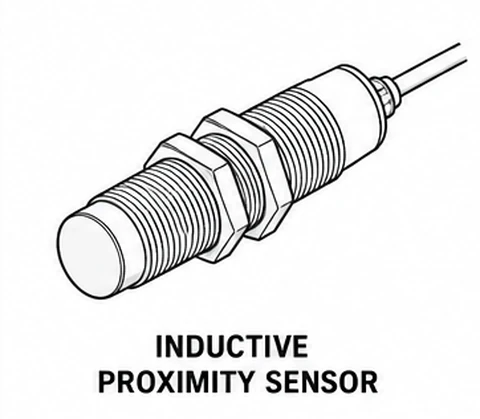
Inductive Proximity Sensor
A coil generates an oscillating magnetic field at the sensing face; a metal target entering that field damps the oscillation and triggers the output. Detects metal only, non-contact, very short range.
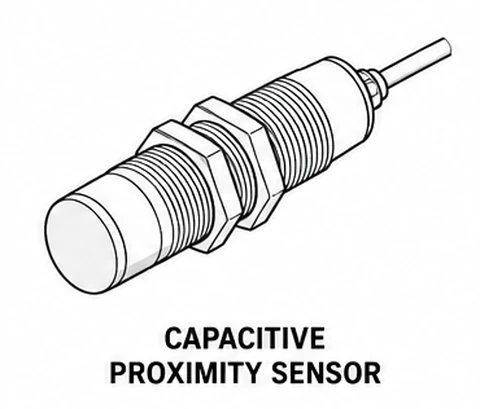
Capacitive Proximity Sensor
Looks almost identical to an inductive sensor but senses any change in capacitance at the face — so it detects metals, plastics, liquids and powders alike, through a non-metallic wall if needed.
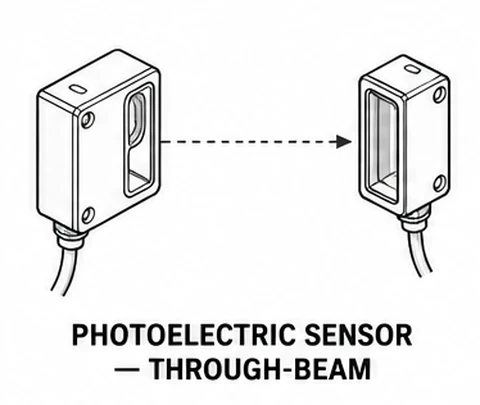
Photoelectric Sensor — Through-Beam
A separate emitter and receiver face each other across the detection zone; anything breaking the beam is detected. The longest range and most reliable of the three photoelectric styles, at the cost of needing both sides wired and aligned.
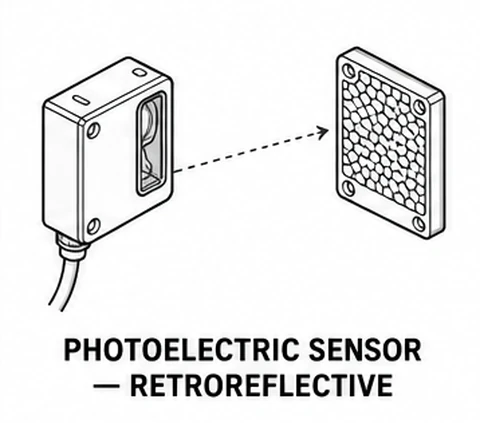
Photoelectric Sensor — Retroreflective
A single sensor unit bounces its beam off a dedicated reflector target back to its own receiver. Only one side of the machine needs power and wiring, at somewhat shorter range than through-beam.
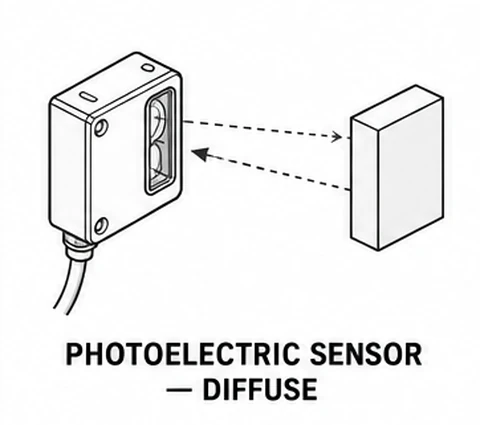
Photoelectric Sensor — Diffuse
The sensor bounces its beam directly off the target itself back to its own receiver — no reflector or opposite-side unit needed. Shortest, least consistent range of the three, since detection depends on the target's own reflectivity.
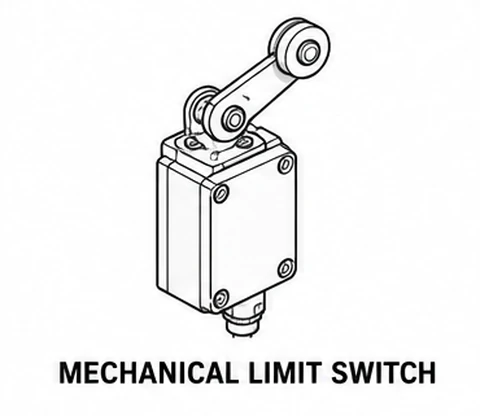
Mechanical Limit Switch
A lever or plunger physically contacts the target and trips an internal mechanical switch. No electronics in the sensing path — about as rugged and simple as position detection gets, at the cost of physical wear and the need for actual contact.
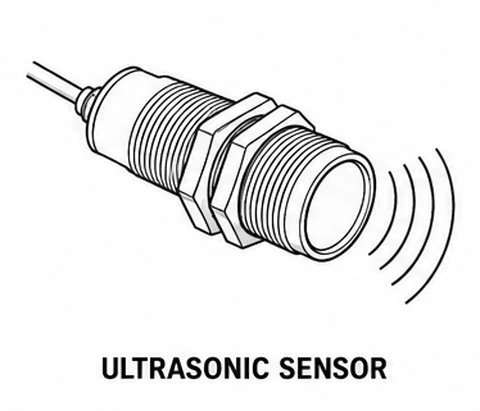
Ultrasonic Sensor
Sends out a burst of high-frequency sound and times the echo to find distance. Works on almost any material — including clear glass and liquids that defeat optical sensors — but is slower and less precise than a laser at long range.
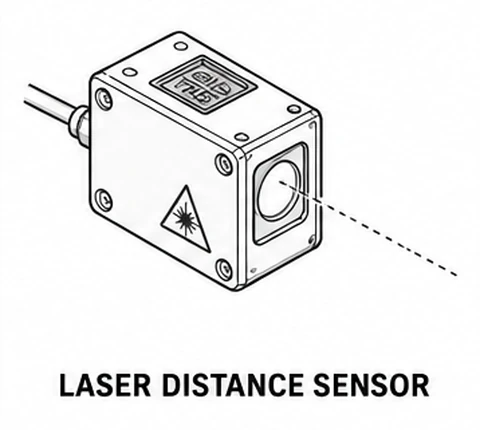
Laser Distance Sensor
Measures distance by timing or triangulating a laser spot rather than a simple on/off detection — gives an actual distance value, not just presence, with sub-millimetre repeatability over a useful range.
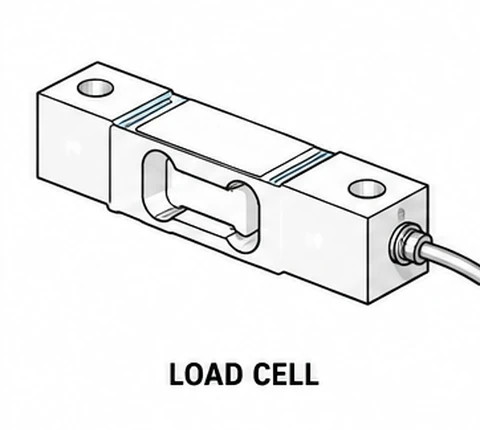
Load Cell
A strain-gauge element bonded to a metal body flexes minutely under load, producing a signal proportional to force. The standard way to measure weight or force directly rather than infer it from something else.
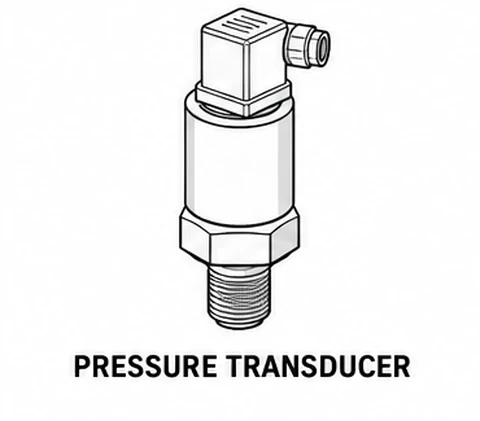
Pressure Transducer
A diaphragm deflects under line pressure and an internal element converts that deflection into an electrical signal, giving a continuous pressure reading rather than a simple threshold switch.
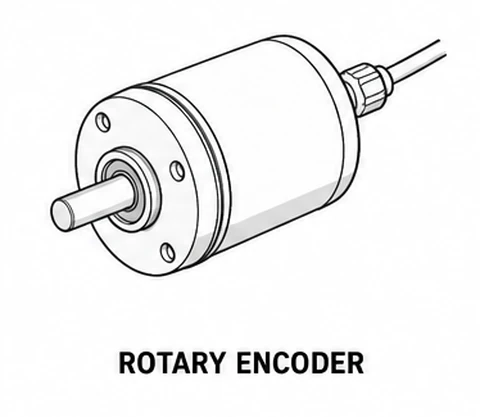
Rotary Encoder
Mounts on a rotating shaft and outputs a signal proportional to angle or a count of pulses per revolution — incremental encoders count relative movement, absolute encoders report actual position even after a power cycle.
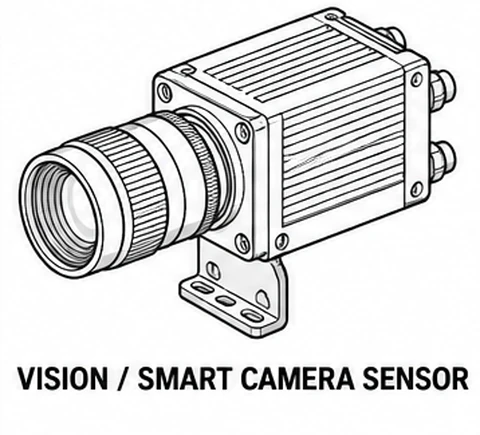
Vision / Smart Camera Sensor
A camera with onboard image processing that can check multiple features, measure dimensions, read codes or verify orientation in a single frame — where a simple presence sensor would need several separate units to do the same job.
Quick-Scan Table
| Sensor Type | Key Feature | Typical Use |
|---|---|---|
| Inductive Proximity Sensor | Metal-only, non-contact, short range, very rugged | Detect a metal object at very short range without contact — end-of-travel on a cylinder rod, gear-tooth counting |
| Capacitive Proximity Sensor | Detects any material, can sense through a non-metallic wall | Detect a non-metallic object — plastic, wood, liquid or powder level through a container wall |
| Photoelectric Sensor — Through-Beam | Longest range, most reliable, needs both sides mounted | Long-range detection (several metres) or reliable detection of small, thin, or fast-moving objects |
| Photoelectric Sensor — Retroreflective | Medium range, single-side mounting, needs a reflector | Medium-range detection where only one side of the machine is accessible for mounting |
| Photoelectric Sensor — Diffuse | Short range, single-unit, no reflector needed | Short-range object detection where mounting a reflector or opposite-side emitter isn't practical |
| Mechanical Limit Switch | Contact-based, mechanically simple, very rugged | Simple, rugged end-of-travel or door/guard interlock detection needing definite mechanical contact |
| Ultrasonic Sensor | Works on any material including clear/reflective, moderate precision | Detecting clear or transparent objects (glass, clear plastic) that optical sensors struggle with |
| Laser Distance Sensor | Precise distance measurement, longer range than proximity types | Precise, repeatable distance or position measurement over a longer range than a proximity sensor |
| Load Cell | Direct weight/force measurement, needs signal conditioning | Measuring weight or force directly — batching, filling, or overload protection |
| Pressure Transducer | Continuous pressure reading, threads directly into the line | Monitoring pneumatic or hydraulic circuit pressure for control or fault detection |
| Rotary Encoder | Shaft speed, position and direction feedback | Measuring shaft speed, position or direction on a motor or rotating axis |
| Vision / Smart Camera Sensor | Multi-feature inspection, measurement, code reading in one unit | Verifying part orientation, presence of multiple features, or reading a code or label in one check |
Explanatory Notes
Inductive and capacitive sensors look alike but behave very differently
Both are short-range, cylindrical, threaded-barrel sensors that are easy to mistake for each other on a shelf. An inductive sensor only reacts to metal; a capacitive sensor reacts to almost anything with enough mass or dielectric difference from air — including through a container wall. Specifying the wrong one is a common and entirely avoidable mistake.
The three photoelectric styles trade range for wiring simplicity
Through-beam needs two separate units wired on opposite sides of the target path but gives the longest range and highest reliability. Retroreflective needs only one side wired, at the cost of a reflector target and somewhat shorter range. Diffuse needs no reflector or opposite unit at all, but its range and reliability depend on the target's own reflectivity — the least consistent of the three.
When a contact switch beats a non-contact sensor
Non-contact sensors avoid mechanical wear, but a mechanical limit switch is often the more dependable choice in a genuinely harsh environment — heavy contamination, extreme vibration, or where a simple, unambiguous "made contact or didn't" signal is worth more than avoiding wear on a low-cycle-count application.
Presence detection vs. measurement
Proximity and photoelectric sensors mostly answer yes/no questions — is something there or not. Ultrasonic, laser distance, load cells and pressure transducers instead output a continuous value — how far, how heavy, how much pressure — which is what a control system needs for anything beyond simple on/off logic.
Related tools
For selecting the motor and gearbox that a sensor-driven axis will control, see Motor & Gearbox Selector. For sizing the fasteners that mount a sensor bracket, see Bolt Grades — Axial, Shear & Torque.